Showing posts with label History. Show all posts
Wednesday, December 4, 2013
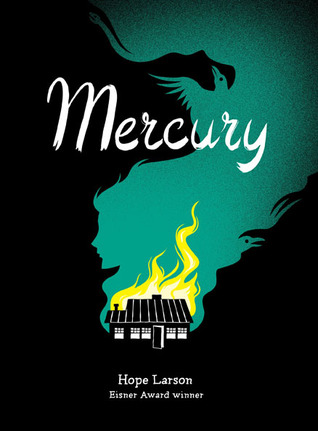
MERCURY
By Hope Larson
Published by Atheneum
Copyright © 2010
Review by Anthony Kendrick
“Mercury” is, for me, the embodiment of a great graphic novel. Larson tells a strong story that is realistic with just a hint of magic. And her illustrations show so well just what can be done in simple black and white.
Josie Fraser has her heart set on her best friend’s brother Jonathan, until a stranger by the name of Asa Curry comes to the farm. He seems like a good God fearing young man and he is handsome to boot. He has come to propose a business venture with Josie’s father, he wants to form a partnership with him and mine for gold on his property. Josie falls in love with him and they plan to marry, but she soon learns that Asa isn’t what he seems.
150 years later Josie’s descendant, Tara Fraser, is living with her Aunt in the same town. Tara’s mother has been working in Alberta since their house burned down back home. Her mother wants to sell the family property and have Tara move to Alberta with her, but Tara is less than enthused about this idea. That house and property had been in Tara and Josie’s family for a long time, and Tara isn’t ready to give up on it.
As we read Josie’s story slipping into tragedy and sadness, we simultaneously get to read of Tara’s story rising from tragedy and sadness into hope that has its roots in the Nova Scotia Gold Rush.
Hope Larson takes us to a place that most of us have never been, or even thought of going, and she takes us to a time and event that we didn’t even know happened. I had no idea that there was a Nova Scotia gold rush, but there was one in the 1860’s and beyond. In truth there is still small scale gold mining there today. I love stories that can inform and transport you to such events.
In addition to the story the artwork is wonderful. The black and white frames really move the story along and Larson has a real knack for conveying emotion with facial expressions. Another thing that I noticed from page one is that her drawing style seems to be slightly influenced by Jeff Smith, writer and illustrator of the Bone graphic novels. (One of the best, if not the best, graphic novels ever.) I absolutely love Smith’s style and I love Larson’s just as much.
Mercury is suitable for most teens and the characters are very relatable. If, like me, you love graphic novels that are heavier on story and relatable characters rather than on out of this world color graphics and superheroes, then Mercury is definitely for you.
HITCH
By Jeanette Ingold
Published by Harcourt, Inc.
Copyright © 2005
Review by Anthony Kendrick
Moss Trawnley is 17 and he is doing everything he can to keep his family afloat. Considering that he is living during the tail end of the great depression and he still has his job at an airfield in Texas he feels pretty hopeful. He is able to send money home to his family in Louisiana every month, he is planning to go to radio repair school, and he has girlfriend named Beatty. However, when Moss suddenly loses his job his dreams seem to be turned on end.
After locating his father in Montana, Moss decides to sign up for a hitch with the Civilian Conservation Corps where he will get 3 squares and a cot and two-thirds of his pay will be sent home to help his family. Moss endures extreme weather and troublesome cabin mates, but he also learns what it takes to be a good man and a leader. He learns the meaning and value of hard work, helping others, and of loyalty.
The Civilian Conservation Corps was one of Franklin Delano Roosevelt’s initial New Deal programs designed to put the nation’s young men to work during the Great Depression. They were charged with among other things the tasks of reforestation, dam and reservoir construction, and park restoration. Ingold tells a fascinating story that shows why a young man might join the CCC and what camp life might be like.
More than just being an overview of the CCC though, she creates a likeable protagonist for us who is coping with internal and external conflicts. And she highlights the proper way to deal with those conflicts. While reading Moss’ story you are waiting for him to lash out because it is the natural first instinct, but he learned from his experience what happens when you do that. Moss is a flawed character but he is good at heart, accepts subtle direction, and learns the best ways to lead.
In addition to Moss, she shows young men and women who have many different talents and passions. I thought it was great that there were young men who loved to read and were good in the kitchen, and that there were young ladies who were pilots and were interested in the family farm. It is a reminder that it is our abilities and interests that should guide our work and passions, not our sex.
While the characters in this story tend to be 17 and older, I feel that youths 12 and up would enjoy this story. This book would also be well used in middle/high school language arts classes to make a cross curriculum connection with U.S. History in particular the Great Depression and the New Deal era.
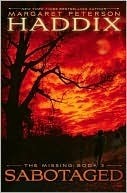
THE MISSING BOOK 3 - SABOTAGED
By Margaret Peterson Haddix
Published by Simon & Schuster
Copyright © 2010
Review by Anthony Kendrick
Another Dare-ing adventure through time with JB, Katherine, and Jonah. Our time traveling trio will try to solve the history mystery of the Roanoke Colony.
Jonah and Katherine are set to take Andrea back in time to merge with her tracer and do what needs to be done to repair the timeline. Their destination is coastal North Carolina around the end of the 16th century where, and when, the Roanoke colony suddenly disappeared. There seems to be a change in the travel plans though when an unknown stranger causes a problem with the elucidator and they don’t get dropped where they should on the timeline. Not only that, but they lose the elucidator and they have no contact with JB. Does he even know where they are? Jonah, Katherine, and Andrea are going to have to figure out how to fix time on their own if they are to have any hope of escape.
Haddix has found a way to mix science fiction and social studies education together in a neat package with “The Missing” series. Many kids aren’t that interested in history itself, but what happens if you time travel and get dropped into the middle of history? Now that is interesting! I commend Haddix because she researches her history well and feeds the story pertinent information about it as needed to move story along. Nowhere does she add a history lesson for the sake of a history lesson. Kids would sniff this out in a heartbeat. Social Studies education is sorely lacking in American primary education today, and I applaud anyone who can include it in the creation of entertainment.
From a pure enjoyment stand point, children 8 years old and up will enjoy this series. They will love the time travel plot where it takes a couple of kids to save time. They will also enjoy its main characters. Haddix does a good job of writing the sibling interaction between Jonah and Katherine so children with brothers or sisters will really feel it. The author also helps the tone of her plot by not making the book too humorous. Part of the fun of time travel sci-fi is the childlike belief that it is just within reach of the realm of possibility, even though we know it isn’t. Too many laughs would probably keep pushing the story out of that realm.
For me personally, I loved the first book but I couldn’t latch on to the second and third wholeheartedly. This third book at 360 pages just moves too slowly for me with all the questions of what the characters should and shouldn’t do and explanations of time and tracer movement. What keeps me going in this series is the history. I was interested in knowing how the author explained the Roanoke Colony’s disappearance, and I was quite pleased with that. I understand, however, how all the explanations help young readers to wrap their mind around the story and take it seriously. I would definitely recommend using this book in conjunction with language arts to bring more attention to history in our classrooms. Stories like this just might grab a child’s attention and make them want to learn on their own.
Tuesday, December 3, 2013
LITTLE WHITE DUCK: A CHILDHOOD IN CHINA
By Na Liu
Illustrated by Andres Vera Martinez
Published by Graphic Universe
Copyright © 2012
Review by Anthony Kendrick
What was your childhood like? How does your childhood compare to your parents or you’re your grandparents childhood? Have you ever asked them about their life?
Na Liu was born in Communist China in the 1970’s at the end of the Cultural Revolution. This was a time of great turmoil but also great change, the China of that time was very insular, but it would slowly open up to the rest of the world. Na tells 8 stories from her childhood to share with others what it was like for a child in China then, and how it compares to her parents and grandparents childhoods.
This book was, and was not, what I expected. I expected to see a dilapidated conformist environment, and this I did. That being the case I expected Na to tell me how horrible it was there and to rail against the Chinese government, but she didn’t. With the help of her husband and illustrator, Andres, she describes not just the pains but the joys of childhood in China. She actually points out how much better her childhood was as compared to previous generations and as compared to children in other parts of her country.
At the end of the book Na and Andre also provide some helpful components: a Chinese words glossary, a timeline of significant dates in Chinese History, Na Liu’s brief biography, translations of some Chinese characters, and the map of China and Hubei Province.
I found this book to be enlightening, enjoyable, and educational. It should appeal to 5th -8th graders or any reader interested in Chinese history and mythology.
Illustrated by Andres Vera Martinez
Published by Graphic Universe
Copyright © 2012
Review by Anthony Kendrick
What was your childhood like? How does your childhood compare to your parents or you’re your grandparents childhood? Have you ever asked them about their life?
Na Liu was born in Communist China in the 1970’s at the end of the Cultural Revolution. This was a time of great turmoil but also great change, the China of that time was very insular, but it would slowly open up to the rest of the world. Na tells 8 stories from her childhood to share with others what it was like for a child in China then, and how it compares to her parents and grandparents childhoods.
This book was, and was not, what I expected. I expected to see a dilapidated conformist environment, and this I did. That being the case I expected Na to tell me how horrible it was there and to rail against the Chinese government, but she didn’t. With the help of her husband and illustrator, Andres, she describes not just the pains but the joys of childhood in China. She actually points out how much better her childhood was as compared to previous generations and as compared to children in other parts of her country.
At the end of the book Na and Andre also provide some helpful components: a Chinese words glossary, a timeline of significant dates in Chinese History, Na Liu’s brief biography, translations of some Chinese characters, and the map of China and Hubei Province.
I found this book to be enlightening, enjoyable, and educational. It should appeal to 5th -8th graders or any reader interested in Chinese history and mythology.
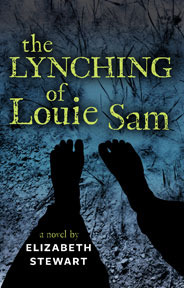
THE LYNCHING OF LOUIE SAM
By Elizabeth Stewart
Published by Annick Press
Copyright © 2012
Review by Anthony Kendrick
We all like to think that we are good people, that given the choice of standing up for someone very different from us who is in desperate need or joining in with our peers who are injuring them, that we would do the right thing. But throughout history there were a litany of people who just stood by and let bad things happen. “The Lynching of Louie Sam” is likely the story of just such an event.
It’s 1884 in the Washington territory and the settlers in more remote parts of the territory stick close together for their safety and livelihood. While life is relatively peaceful, there is still tension with the Native peoples. George Gillies and his family live in what is now Whatcom County, Washington; just miles away from the international border with Canada. One Sunday on their way to church, George and his three siblings come across the burning house of their neighbor James Bell and they find that he has been murdered. All fingers point to a native boy, Louie Sam, who had been seen in the area that day. A lynch mob is formed to get Louie Sam; George and his friend Pete are eager to follow the mob into Canada to impress their fathers and their friends. Soon however, George and his father begin to have doubts about Louie Sam’s guilt. Will they keep quiet to protect their own, or will they do what is right?
“The Lynching of Louie Sam” is a historical novel that is based on an actual event. While the characters in the book were real people, any of their thoughts and actions, beyond the event in question, are merely great story telling. Elizabeth Stewart has written a gripping story about racism, injustice, and conscience. It even loosely touches on the issue of bullying. I think that Stewart explores the questions involved in these issues well: Is it more important to do what is right and see justice served, or to protect your own no matter what? And do you do what’s right to ease your conscience, or do you do what’s right because it’s right?
Stewart fleshes out a very complex cast of characters, especially in George Gillies. George is fifteen; he is trying to prove to his father and his friends that he is a man. This task is difficult because his best friend, Pete, constantly reminds him that he is a year older and treats him as such. In addition he has a very impetuous younger brother who seems to struggle less with his sense of right and wrong. Part of George’s problem is that he isn’t brash like many of the men and boys he knows, but he is thoughtful. In his one instance of definitive action and brashness the situation goes awry. So what does it mean to be a man?
There is just so much to enjoy about this book. The story is sad but riveting, the characters are complex, it touches home here in the Pacific Northwest, and the story’s moral is universal when considered alongside so many tragic events from history and modern times. I highly recommend this book for adults and youth in 7th grade and up.
Published by Annick Press
Copyright © 2012
Review by Anthony Kendrick
We all like to think that we are good people, that given the choice of standing up for someone very different from us who is in desperate need or joining in with our peers who are injuring them, that we would do the right thing. But throughout history there were a litany of people who just stood by and let bad things happen. “The Lynching of Louie Sam” is likely the story of just such an event.
It’s 1884 in the Washington territory and the settlers in more remote parts of the territory stick close together for their safety and livelihood. While life is relatively peaceful, there is still tension with the Native peoples. George Gillies and his family live in what is now Whatcom County, Washington; just miles away from the international border with Canada. One Sunday on their way to church, George and his three siblings come across the burning house of their neighbor James Bell and they find that he has been murdered. All fingers point to a native boy, Louie Sam, who had been seen in the area that day. A lynch mob is formed to get Louie Sam; George and his friend Pete are eager to follow the mob into Canada to impress their fathers and their friends. Soon however, George and his father begin to have doubts about Louie Sam’s guilt. Will they keep quiet to protect their own, or will they do what is right?
“The Lynching of Louie Sam” is a historical novel that is based on an actual event. While the characters in the book were real people, any of their thoughts and actions, beyond the event in question, are merely great story telling. Elizabeth Stewart has written a gripping story about racism, injustice, and conscience. It even loosely touches on the issue of bullying. I think that Stewart explores the questions involved in these issues well: Is it more important to do what is right and see justice served, or to protect your own no matter what? And do you do what’s right to ease your conscience, or do you do what’s right because it’s right?
Stewart fleshes out a very complex cast of characters, especially in George Gillies. George is fifteen; he is trying to prove to his father and his friends that he is a man. This task is difficult because his best friend, Pete, constantly reminds him that he is a year older and treats him as such. In addition he has a very impetuous younger brother who seems to struggle less with his sense of right and wrong. Part of George’s problem is that he isn’t brash like many of the men and boys he knows, but he is thoughtful. In his one instance of definitive action and brashness the situation goes awry. So what does it mean to be a man?
There is just so much to enjoy about this book. The story is sad but riveting, the characters are complex, it touches home here in the Pacific Northwest, and the story’s moral is universal when considered alongside so many tragic events from history and modern times. I highly recommend this book for adults and youth in 7th grade and up.
THE LAST MUSKETEER
By Stuart Gibbs
Published by Harper
Copyright © 2011
Review by Anthony Kendrick
Meet the Three Musketeers before they were the Musketeers in this thrilling middle ages, middle school adventure.
Greg Rich comes from, well, a rich family. Over the years, however, they have squandered their wealth until it has come to the point that Greg’s parents have to sell the family estate. Fortunately for them there is someone who is more than willing to take everything off of their hands. Michael Dinicoeur, a representative of the L'ouvre in Paris, buys everything from the Rich estate and flies the family to France to deliver their many antiquities. But something just doesn’t seem right to Greg, and as they hand over the last item he soon learns that his gut is right. He and his family are thrust back in time and his parents are captured. If he is going to save them, and the world, he is going to have to find Athos, Porthos, Aramis, and D’Artagnan to help him.
“The Last Musketeer” is a fabulous romp back in time. It is full of action, adventure, and history. There is sword play (though I wish there was more), cannon fire, doppelgangers, secret missions, and narrow escapes. Gibbs also does well in describing what Paris of 1615 looks and smells like. He doesn’t glamorize it as some movies and books do. It’s really quite gross, which makes it perfect for boys age 10 and up. Really though, any youth (boy or girl) with an interest in historical fiction, especially the Musketeers, will like this book.
Published by Harper
Copyright © 2011
Review by Anthony Kendrick
Meet the Three Musketeers before they were the Musketeers in this thrilling middle ages, middle school adventure.
Greg Rich comes from, well, a rich family. Over the years, however, they have squandered their wealth until it has come to the point that Greg’s parents have to sell the family estate. Fortunately for them there is someone who is more than willing to take everything off of their hands. Michael Dinicoeur, a representative of the L'ouvre in Paris, buys everything from the Rich estate and flies the family to France to deliver their many antiquities. But something just doesn’t seem right to Greg, and as they hand over the last item he soon learns that his gut is right. He and his family are thrust back in time and his parents are captured. If he is going to save them, and the world, he is going to have to find Athos, Porthos, Aramis, and D’Artagnan to help him.
“The Last Musketeer” is a fabulous romp back in time. It is full of action, adventure, and history. There is sword play (though I wish there was more), cannon fire, doppelgangers, secret missions, and narrow escapes. Gibbs also does well in describing what Paris of 1615 looks and smells like. He doesn’t glamorize it as some movies and books do. It’s really quite gross, which makes it perfect for boys age 10 and up. Really though, any youth (boy or girl) with an interest in historical fiction, especially the Musketeers, will like this book.
Subscribe to:
Comments (Atom)